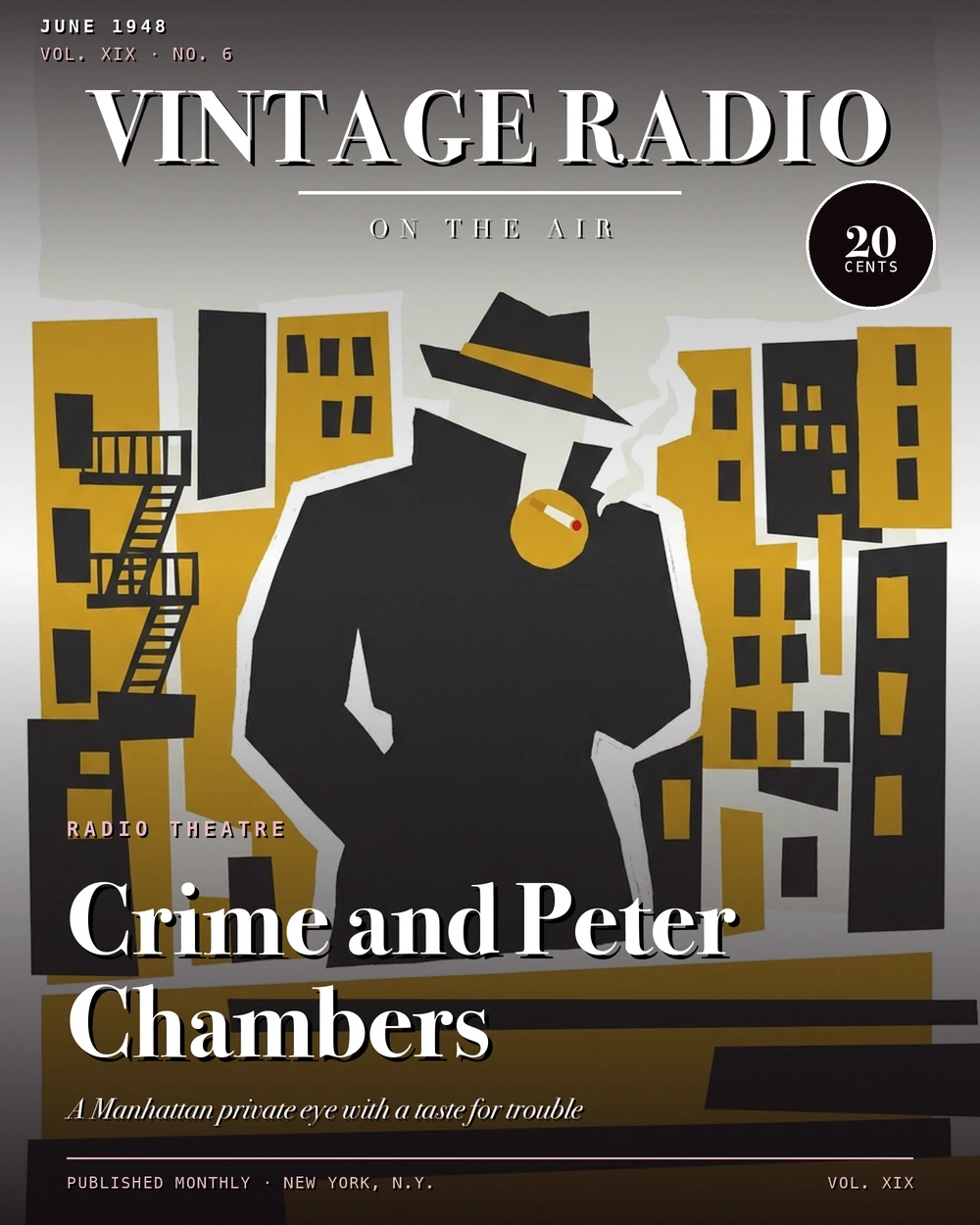
Crime and Peter Chambers
Henry Kane's Detective Comes to Radio
Henry Kane had already given Peter Chambers a long runway before the radio series launched. The character first appeared in a 1947 Esquire short story called "A Glass of Milk," and by April 1954 Kane had written eight Chambers novels for Simon & Schuster, who had promoted him on debut as "a worthy successor to Dashiell Hammett." That's the foundation Crime and Peter Chambers was built on — a New York private eye with a well-established personality, a taste for women, and a $500-a-day fee that the radio scripts kept intact from the books.
Kane was unusual in that he didn't just hand over the property and collect royalties. He served as creator, producer, and writer on the series, and according to research by The Thrilling Detective Web Site, co-directed alongside Fred Weihe. Kane had trained as a lawyer at Brooklyn Law School before turning to full-time fiction writing, and he brought a certain procedural instinct to the character — most visibly in Chambers' habit of cooperating with police rather than working around them, an unusual trait for fictional private detectives of the era. The radio scripts kept that detail too. Peter Chambers was introduced each episode as "a private investigator, duly licensed and duly sworn," and that phrase signals exactly the tone Kane was after: professional, legitimate, a bit sardonic.
The series aired on NBC on Tuesday nights at 9:30, running thirty minutes per episode from April 6 to September 7, 1954. It was transcribed — pre-recorded in New York — which was standard for the period but worth mentioning because the New York production base shows up in the casting, a deep bench of stage and radio actors that the networks kept busy in the mid-1950s.
Dane Clark as Peter Chambers
The casting of Dane Clark in the lead role is the most interesting single decision the production made. Clark's screen identity at Warner Bros., where he had signed in 1943, was the scrappy working-class tough guy — his breakthrough film had been Action in the North Atlantic alongside Humphrey Bogart, and film exhibitors had voted him the 16th most popular star at the U.S. box office in 1945. His stage name, by his own account, had been given to him by Bogart himself, with columnist Louella Parsons noting that Warner Bros. had briefly weighed "Zane Clark" before settling on Dane Clark.
What the Chambers role asked for was something slightly different. The character was framed as a "playboy detective" — smoother, more quipping, with an eye for women mixed in with the casework. That was a contrast to Clark's typical screen tough-villain roles, and the glib dialogue the scripts favored was calibrated to play into Clark's persona while nudging it in a lighter direction. Whether that tension worked in practice is a fair question, but the combination of Clark's established toughness and the more wisecracking detective format was at least a deliberate creative choice rather than an accident of casting.
Clark was, by any measure, an accomplished actor with an unusual biography. He graduated from Cornell in 1936, earned a law degree from St. John's University in 1938, and during the Depression had worked as a boxer, minor league baseball player, construction worker, and model before turning to acting. His Broadway work included taking over the role of George in the 1937 production of Of Mice and Men from Wallace Ford. During the 1950s he was awarded life membership in The Actors Studio, one of a small group of actors granted that distinction outside the organization's founding members. At the same time Crime and Peter Chambers was running, he was also co-starring in the NBC television drama Justice, playing attorney Richard Adams.
The Supporting Cast and Production Team
The production assembled a substantial supporting cast, most of them working steadily in New York radio and television. Bill Zuckert played Lt. Parker, the police contact who served as Chambers' institutional counterpart. Zuckert — born in the Bronx in 1915, radio career beginning in 1941 — was a veteran of hundreds of dramatic programs and served on the boards of both the Screen Actors Guild and the American Federation of Television and Radio Artists. He would go on to a long television career, including a guest appearance as Sheriff Johnny Behan in the Star Trek episode "Spectre of the Gun" and multiple appearances on Columbo.
Beyond Zuckert, the cast at various points included Everett Sloane, Evelyn Varden, Leon Janney, Fran Carlon, Lesley Woods, Edgar Stehli, Patricia Wheel, Roger DeKoven, Bryna Raeburn, and others — Donald Buka, Joe de Santis, Ralph Bell, and Nelson Olmsted among them. Fred Collins announced. The theme music was noted by listeners as particularly distinctive, though the composer has never been identified in any known source. Fred Weihe directed the bulk of the run.
The pilot, "Bruce Burke Murder Frame-Up," broadcast April 6, 1954, set the template: a single named case, a New York setting, Chambers working the investigation while maintaining his cooperative relationship with the police. Subsequent episodes ranged across murders, robberies, and kidnappings, with titles that often foregrounded the name of the central figure — "Charles Avon, Druggist," "Abigail Chrisenberry," "Angela Wentworth's Uncle," "Donald Sloane — Embezzler" — a format that gave each installment the feeling of a case file pulled from a drawer.
Why It Didn't Last
Twenty-four episodes were reportedly produced across the run, with 21 surviving as of the certified set issued November 15, 2008. That's not a long run by any standard, and the reason seems to have been a combination of weak plotting and an audience that didn't build. The Thrilling Detective Web Site concluded that "the series showed signs of being put together in a hurry" and that weak plots failed to attract many listeners. The glib dialogue Kane favored played well in the novels — Art Scott, writing in 1001 Midnights, described the Chambers books as providing "enjoyable light entertainment" while noting the characters' "peculiarly arch" delivery — but on radio, where every episode had to deliver a satisfying plot in thirty minutes, that archness without strong story construction wasn't enough to hold an audience.
The show has been grouped by researchers at The Great Detectives of Old Time Radio alongside a string of comparable mid-1950s short runs — Nero Wolfe, Mr. I.A. Moto, and Rocky Fortune among them — six-month network series that came and went without establishing themselves. It's a familiar pattern for the period: a recognizable fictional detective, a capable lead actor, a credentialed creator, and still not quite enough traction to survive past a summer run.
What Came After
The cancellation of the radio series didn't end either the character or the careers involved. Kane continued writing Peter Chambers novels until 1972 — approximately 30 titles in total, the last being Kill for the Millions — though The Thrilling Detective Web Site notes that his later novels shifted toward more explicit content in an attempt to revive the series, a strategy it characterizes as ultimately unsuccessful. Kane also wrote under the pseudonyms Anthony McCall, Kenneth R. McKay, and Mario J. Sagola, produced screenplays for radio, television, and film, and wrote an original novel featuring the television character Peter Gunn. A jazz enthusiast alongside everything else, he published How to Write a Song in 1962, featuring interviews with Duke Ellington and Hoagy Carmichael.
Dane Clark kept working steadily on television through the following decades. In 1959 he reprised Humphrey Bogart's role as Slate Shannon in the short-lived syndicated series Bold Venture. In the early 1970s he played Lt. Arthur Tragg in 14 episodes of the CBS revival The New Perry Mason. Bill Zuckert worked in television until late in his career, dying in 1997 at the Motion Picture & Television Country House and Hospital in Woodland Hills.
Crime and Peter Chambers sits somewhere between a promising idea and an underfed execution — a show with a legitimate literary source, an experienced creator who kept direct control, and a lead actor with real screen presence, but not quite enough careful script construction to turn that into something durable. What it offers now is a clear snapshot of the New York radio production world in 1954 and a reasonably faithful translation of Kane's character, played straight by people who knew what they were doing.